Logo

NexaCount & Advisory Services (Pty) Ltd

NexaPulse

Weekly Intelligence Brief · 21 Jul 2026

Priority Rating (1–10): Rating that measures the overall importance of an item by assessing its timeliness, regulatory urgency, client exposure, and advisory impact.

21 Jul 2026 · 7 articles
FeaturedNexaCount
9
ConCourt's anti-avoidance tax principles in Absa case land their first test - Moneyweb

17 Jul 2026 · moneyweb · 1 min read

The Cape Town Tax Court recently applied the Constitutional Court’s anti-avoidance principles from the Absa case to a new dispute. The case involved a dividend-stripping transaction utilizing a share subscription and buyback structure. Ruling for the South African Revenue Service, the court reaffirmed the choice principle for tax-efficient structuring. Crucially, it established that taxpayers cannot insert unnecessary transaction steps designed solely for tax avoidance. This marks the first major test of these clarified General Anti-Avoidance Rules.

Business Impact

This ruling significantly sharpens the boundaries of legitimate corporate tax planning in South Africa. By enforcing the Absa precedent, the court signaled that complex transaction structures remain highly vulnerable to anti-avoidance attacks by the revenue service. Taxpayers face increased scrutiny when organizing deals, particularly share subscriptions and buybacks. Moving forward, businesses and their advisors must rigorously ensure every transaction step possesses a genuine commercial rationale, rather than serving primarily to prevent severe, unexpected tax reassessments.

Read full article →
Tax & Compliance
1
9
Plato’s Cave, AI, and the law’s search for truth

01 Jul 2026 · De Rebus · 1 min read

The De Rebus article explores the philosophical dangers of Artificial Intelligence in the legal profession, framing A…

Full summary & impact

The De Rebus article explores the philosophical dangers of Artificial Intelligence in the legal profession, framing AI through Plato’s Allegory of the Cave. Just as cave prisoners mistake flickering shadows for reality, legal practitioners risk confusing AI-generated content—which simulates authoritative truth—with genuine evidence. The core issue is that AI does not just present facts; it creates persuasive illusions that can mislead courts and counsel. The law’s traditional reliance on disciplined standards of proof is now challenged by these sophisticated digital fabrications.

Business Impact

This analysis necessitates a radical shift in how legal practitioners and business, engage with AI tools. Lawyers must treat AI research with extreme skepticism, recognizing that AI models are "puppets" capable of producing convincing but false legal "truth." Practitioners have a professional obligation to maintain an independent, questioning mind and verify every assertion. The legal sector must move from passive acceptance of digital research to a method of active, rigorous verification, ensuring that the "shadows" of AI do not replace the fundamental duty to defend the truth.

Read full article →
2NexaCount
8
Important information for anyone who was auto-assessed by SARS in South Africa

13 Jul 2026 · moneyweb · 1 min read

South Africans who were auto-assessed by the South African Revenue Service (SARS) this filing season can submit corre…

Full summary & impact

South Africans who were auto-assessed by the South African Revenue Service (SARS) this filing season can submit corrected tax returns if their assessments lack crucial data. Tax experts warn that auto-assessments frequently omit essential deductions, such as excess retirement annuity contributions carried forward from previous years, freelance income, and home office expenses. Because SARS systems only process data directly provided by employers and financial institutions, taxpayers must proactively review their notices before the October 2026 deadline to secure all eligible tax relief.

Business Impact

This necessitates a more proactive approach from taxpayers and accounting professionals regarding automated compliance. Rather than blindly accepting auto-assessments, individuals must manually reconcile their final assessments against independent financial records. This is particularly important for retirement contributions and out-of-pocket expenses not captured by standard payroll data. For advisory practices, this creates a critical service opportunity to verify client auto-assessments before deadlines. Failing to correct these system omissions could result in taxpayers unnecessarily forfeiting significant lawful deductions.

Read full article →
3NexaCount
8
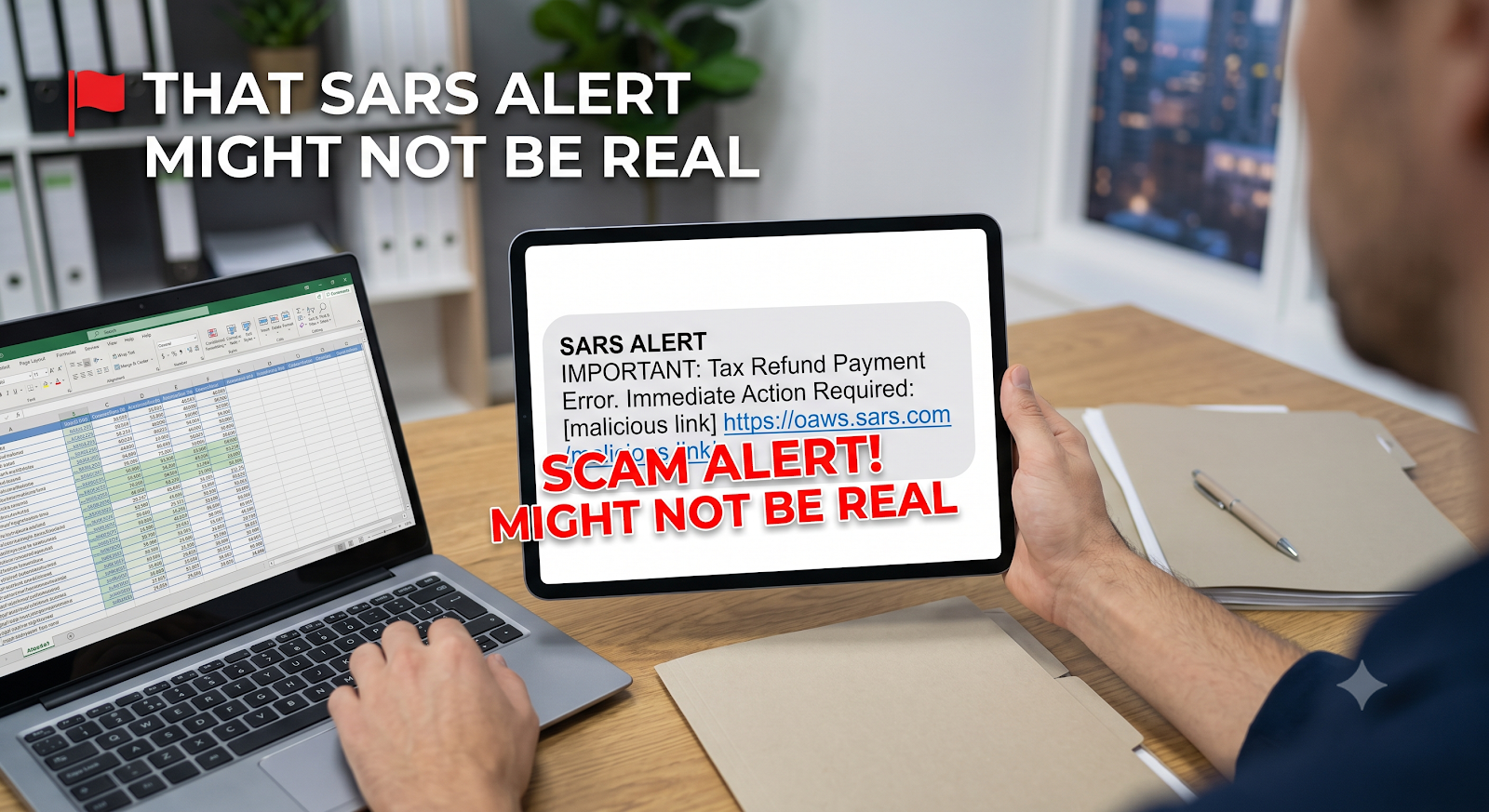
That SARS Alert Might Not Be Real - Snijder & Associates | Audit and Accounting firm

08 Jul 2026 · snijder & associates · 1 min read

During tax season, taxpayers face a significant spike in fraudulent correspondence pretending to be from the South Af…

Full summary & impact

During tax season, taxpayers face a significant spike in fraudulent correspondence pretending to be from the South African Revenue Service (SARS). Scammers commonly deploy four tactics: urgent settlement demands with fake bank details, SMS refund alerts requesting credit card data, threatening letters containing malicious links, and fake compliance notices directing users to spoofed websites. Because SARS shifted entirely to digital communication in May 2025, these sophisticated phishing attempts have become much harder to distinguish from legitimate revenue service correspondence.

Business Impact

This surge in sophisticated tax scams forces accounting practices to enforce stricter internal verification protocols. Because SARS no longer uses physical mail for system-generated letters, digital-first advisory firms must treat unsolicited links or payment demands with extreme caution. Practitioners must actively educate clients to never click direct links or provide banking details via SMS. Instead, all compliance checks, auto-assessments, and payment processing must be securely routed directly through the official SARS eFiling portal to mitigate severe financial fraud and data security risks.

Read full article →
4NexaCount
7
POPIA update: Information Regulator issues an Enforcement Notice for an email data breach

24 Jun 2026 · ebnet · 1 min read

The Information Regulator issued a landmark enforcement notice against the Central Johannesburg TVET College after an…

Full summary & impact

The Information Regulator issued a landmark enforcement notice against the Central Johannesburg TVET College after an employee accidentally emailed personal credential verification reports to unauthorized internal staff. This ruling establishes that under the Protection of Personal Information Act (POPIA), even inadvertent, strictly internal data disclosures constitute a formal "security compromise". Crucially, unlike international regulations like GDPR, POPIA contains no materiality threshold. Consequently, businesses must formally report every data breach, regardless of severity or malicious intent, to the Regulator and affected data subjects.

Business Impact

This strict interpretation forces accounting and advisory practices to fundamentally overhaul their internal data handling procedures. Because any misdirected internal email containing client or employee information triggers mandatory, resource-intensive breach notification protocols, firms can no longer rely on simple email recalls or internal apologies. Practitioners must implement stringent access controls, systematically separate sensitive files, and continuously train staff. Every firm must ensure their Information Officer is registered and prepared to execute formal compliance reporting for even minor, accidental administrative errors.

Read full article →
Advisory
1NexaCount
3
A Guide To Managing And Marketing A Retail Business

22 Jun 2026 · business2sell · 1 min read

A successful retail business requires a strong operational foundation paired with dynamic marketing strategies. This …

Full summary & impact

A successful retail business requires a strong operational foundation paired with dynamic marketing strategies. This guide emphasizes that managing a retail storefront demands rigorous inventory control to optimize cash flow and prevent dead stock. On the marketing side, owners must blend highly visible in-store branding with a robust digital presence, including e-commerce and local SEO. By training staff to deliver exceptional customer service and implementing loyalty programs, retailers can drive customer retention and build long-term brand trust.

Business Impact

For business advisors and accounting practitioners, these retail principles highlight the need to integrate financial oversight with daily operations. Advisors must guide retail clients to adopt automated inventory systems that provide real-time data for accurate cash flow forecasting. Instead of just managing compliance, practitioners can offer strategic value by helping retailers budget for seasonal shifts and marketing expansions. This proactive approach transforms standard accounting functions into comprehensive business advisory that directly supports a retailer’s sustainable growth.

Read full article →
Other
1NexaCount
10
SARS sends South Africans a R62 million VAT fraud warning

19 Jul 2026 · daily investor · 1 min read

The South African Revenue Service (SARS) has issued a stark warning following the 25-year prison sentencing of a clos…

Full summary & impact

The South African Revenue Service (SARS) has issued a stark warning following the 25-year prison sentencing of a close corporation member for a R62 million VAT fraud scheme. Over 12 years, the perpetrator submitted fraudulent refund claims using fabricated invoices and inflated input VAT, combined with extensive money laundering. This landmark conviction underscores the critical legal distinction between aggressively disputing tax assessments through lawful administrative channels and committing deliberate, criminal tax fraud to unlawfully extract funds from the fiscus.

Business Impact

This conviction signals a permanent shift in how SARS investigates anomalous VAT refunds. By leveraging advanced data-driven intelligence, automated risk-detection systems, and third-party partnerships, the revenue service is actively treating fabricated transactions as serious economic crimes rather than simple administrative errors. For accounting practices, this necessitates rigorous verification of client input VAT claims and supporting documentation. Advisors must ensure clients understand that aggressive, undocumented tax positions risk triggering criminal prosecution rather than standard administrative engagements or routine audits.


Read full article →
Nexa Dicta
Pulse Edition · 21 Jul 2026
The New Business Reality: Compliance, AI, and Tax Scrutiny
South African enterprise is standing at a critical juncture. The regulatory environment is tightening rapidly, and the margin for corporate error has completely vanished. Consider the recent POPIA enforcement notice regarding a simple internal email breach. This is a stark warning that the Information Regulator has adopted a strict zero tolerance policy on data security. Companies must fundamentally overhaul their internal data protocols because compliance is no longer a passive administrative function; it is a critical operational mandate. Furthermore, as businesses rush to integrate artificial intelligence, executives must exercise extreme caution. AI can create convincing illusions that threaten professional integrity. Corporate leaders must foster a culture of intense skepticism and rigorous verification to protect their firms from digital fabrications. This demand for proactive defense extends directly into corporate tax strategy. While the automated assessment system at SARS appears to streamline compliance, it is a trap for the unwary. Taxpayers and their financial advisors must manually verify these automated calculations to ensure legitimate corporate deductions are not permanently lost. Compounding this challenge is the massive surge in sophisticated digital tax scams. Accounting practices and corporate finance departments must enforce the strictest verification protocols and route every piece of correspondence through official revenue service channels to prevent catastrophic financial fraud. Moreover, the judicial system is aggressively targeting corporate tax structures. The Constitutional Court principles applied in the Absa case establish a formidable precedent. The courts are making it abundantly clear that every single step in a corporate transaction must possess a genuine commercial rationale. Deals structured solely for tax benefits will be dismantled. Coupled with the recent milestone conviction for a massive VAT fraud scheme, SARS is proving its capability to use advanced data intelligence to prosecute economic crimes. For business leaders and financial advisors, the message is unequivocal. Transparent and commercially sound financial practices, backed by flawless documentation, are the only ways to survive this new era of intense corporate scrutiny.
Nexa Dicta
— Editor
Nexa Prospectus
1 document
01
AGA Strategic Network

Build Your Business on a Solid Foundation

DEFY tradition.

SCALE growth.

QR

Enter for
EVOLUTION

Talk to Us →
fWT
Subscribe / UnsubscribeContact

© 2026 NexaCount & Advisory Services (Pty) Ltd. All rights reserved.

Content Disclaimer

Content Disclaimer

The content of this entire publication, including all articles, documents, information, and editorial commentary, is provided for general informational purposes only and does not constitute professional accounting, financial, or legal advice. Any views, opinions, or comments expressed in editorials or by individual contributors are solely their own and do not necessarily reflect the official position or policies of NexaCount and Advisory Services (Pty) Ltd. NexaCount and Advisory Services (Pty) Ltd accepts no liability for any actions taken, or decisions made, in reliance on this content. Always consult a qualified professional for guidance specific to your circumstances.

Privacy & Data Protection

Privacy & Data Protection

Privacy, POPIA & Professional Disclaimer 1. Identity of the Responsible Party This newsletter is published and distributed by NexaCount & Advisory Services (Pty) Ltd. By subscribing to and interacting with our digital content, you acknowledge the processing of your personal information as outlined in this notice. 2. Professional Disclaimer & Limitation of Liability The business intelligence, news, and opinions curated within this newsletter are provided for general informational purposes only and do not necessarily represent the official views, policies, or individual opinions of NexaCount & Advisory Services (Pty) Ltd, its partners, or its employees. The content herein does not constitute customized financial, tax, legal, or professional advice. Readers are strictly advised to seek independent, tailored professional counsel before making any operational, financial, or compliance decisions based on this material. NexaCount & Advisory Services (Pty) Ltd accepts no liability for any actions taken in reliance on this curated intelligence. 3. Purpose of Data Processing, Tracking & Marketing We process your contact details strictly to deliver professional intelligence briefings, advisory updates, and related commercial communications. Direct Marketing & External Links: This newsletter may contain direct marketing material, promotional offers, and links to affiliated services or third-party websites. NexaCount & Advisory Services (Pty) Ltd is not responsible for the privacy practices or content of external linked sites. Digital Tracking: To optimize our content and ensure the delivery of high-value intelligence, our emails employ tracking markers (including web beacons, pixels, and link tracking). These tools collect telemetry data on user engagement, such as email open rates, timestamps, and clicked links. This data is aggregated to refine our business news curation and is not sold to third parties. Unsubscribe & Consent Withdrawal Your participation in this ecosystem is strictly consensual. You maintain the absolute right to withdraw your consent and request to cease receiving communications at any time. To initiate this process, click the **"Unsubscribe"** link located at the bottom of this email. Please note that while all opt-out requests are actioned, it may take a reasonable processing period for your removal to reflect across all active systems and scheduled marketing distributions. You may also directly email our Information Officer at: fix@nexacount.co.za 5. Data Security & Retention NexaCount & Advisory Services (Pty) Ltd utilizes enterprise-grade digital vaults and secure cloud architecture to protect your personal information against unauthorized access, destruction, or data breaches. Information is retained only for as long as you remain an active subscriber or as required by applicable South African law. 6. Data Subject Rights & Complaints Under the Protection of Personal Information Act, 2013 (POPIA), you possess the right to request access to, correction of, or deletion of your personal data held by us. Direct Queries: For all privacy-related requests or to update your information, please submit a formal request via fix@nexacount.co.za. Information Regulator: If you believe your data has been processed unlawfully, you maintain the right to lodge a formal complaint with the Information Regulator (South Africa) via POPIAComplaints@inforegulator.org.za.